 Optimizing brainfuck compiler

This Python script translates a brainfuck source file into a C/Java/Python source file. Along the way, it performs optimizations on the brainfuck program, described below. Afterward, you run your C/Java/Python compiler or interpreter on the newly generated source code.
Download:  bfc.py
Usage: python bfc.py BrainfuckFile OutputFile.c/java/py
Full example:
python bfc.py mandelbrot.b.txt mandelbrot.ccc -o mandelbrot mandelbrot.c./mandelbrot
Tip: It can be tedious to compile and run a brainfuck program using this tool. For example for C, you might want to put all the commands on one line: python bfc.py myprog.b myprog.c && cc -o myprog myprog.c && ./myprog. Alternatively, you can write a Makefile with rules for compiling, running, cleaning, and so on.
Example and benchmark
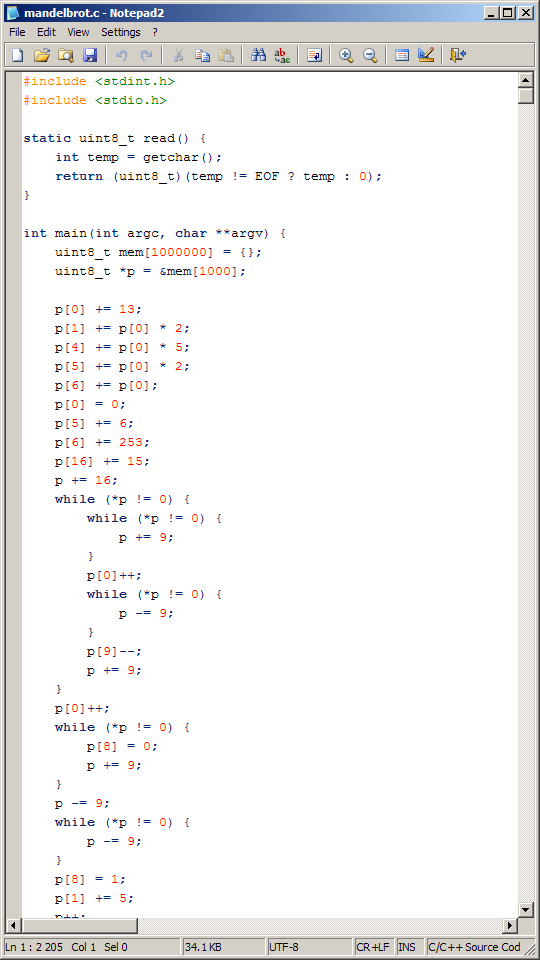
Files:
- Brainfuck (input): mandelbrot.b.txt
- C (output): mandelbrot.c
- Java (output): mandelbrot.java
- Python (output): mandelbrot.py
Benchmark:
| Unoptimized | Optimized | |
|---|---|---|
| C, -O0 | 17.20 s | 2.77 s |
| C, -O1 | 1.09 s | 0.64 s |
| C, -O2 | 1.02 s | 0.66 s |
| C, -O3 | 1.05 s | 0.66 s |
| Java | 41.40 s | 19.20 s |
| Python | 490.00 s | 190.00 s |
All benchmarks above were performed on an Intel Xeon E3-1270 3.40 GHz CPU (single-threaded). The non-optimized source codes are not published because they are uninteresting. Numbers are reported to 3 significant figures. Software-wise, GCC 4.8.2, Oracle Java 1.7.0_51, CPython 2.7.6, and Linux 3.12.6 x86-64 were used.
Note that the speed comparison is not fair because the C code has no bounds checking and can easily trigger undefined behavior, whereas the Java and Python programs are bounds-checked, safe, and deterministic.
Optimizations
I will use this notation: uint8_t *p points to the current cell (which corresponds to the C output from the script).
- Fusing increments/decrements
A real computer can add by not just one, but by almost any number. So for example, we can translate
+++intop[0] += 3;.- Fusing left/right movements
Similarly, we can move the pointer by more than one step – for example, we can translate
>>intop += 2;.- Fusing movements into adds
We can add to / subtract from cells other than the current one. For example, we can translate
>++<intop[1] += 2;, which no longer contains pointer movements.- Postponing movements
In a block of brainfuck commands, if the block consists of only increments/
decrements, left/ right, and input/ output, then we can keep track of the virtual movement and then perform it in one shot at the end of the block. For example, we can translate >+>->intop[1]+=1; p[2]-=1; p+=3;. Note that we have to actually perform the movements before entering a loop/if and before exiting a loop/if.- Simple loops
A moment’s thought should make it clear that
[-]translates top[0] = 0;. But we can generalize further than that. If the loop body has no subloops and no input/output, all the movements add up to 0, and all the increments/ decrements at p[0]add up to −1, then we are basically running the loop bodyp[0]times. So for all the increments/decrements outside of p[0], some multiple ofp[0]is added to that location. For example, we can translate[->+>---<<]intop[1]+=p[0]; p[2]-=p[0]*3; p[0]=0;.- Assign followed by add
Obviously,
p[i] = 0;followed byp[i] += v;can be replaced byp[i] = v;. As well,p[i] = 0;followed byp[i] += p[j] * v;can be replaced byp[i] = p[j] * v;.- Complex loops
Extending the simple loop optimization, if a location other than the loop counter is used as the source for multiply-add and this location is cleared to 0 within the loop, then the loop can be turned into an if-statement. For example, we can optimize
while(p[0]!=0){ p[0]--; p[1]+=2; p[2]+=p[3]*5; p[3]=0; }intoif(p[0]!=0){ p[1]+=p[0]*2; p[0]=0; p[2]+=p[3]*5; p[3]=0; }.
Notes
Technically speaking, this script is called a source-to-source compiler, rather than a typical source-to-machine-code compiler.
To disable optimizations, simply remove the lines that call the
optimize()function.The generated source code uses a large but fixed-size array for the brainfuck memory, with no explicit bounds checking. Thus, the rare brainfuck program that uses a lot of memory will either crash precisely in the Java and Python versions, or exhibit undefined behavior in the C version. This implementation choice is because I didn’t want to deal with the complexity of (for example) resizing the memory array to uphold the illusion of infinite memory for the brainfuck program.
When outputting Java source code, large brainfuck programs may exceed the class file format’s 64-KiB-per-method size limit. My Python script is unable to deal with this situation, but in principle it can be fixed by modifying the Java code generator (in the Python script) to be able to split the brainfuck program into multiple methods based on a pessimistic estimate of the output bytecode size.